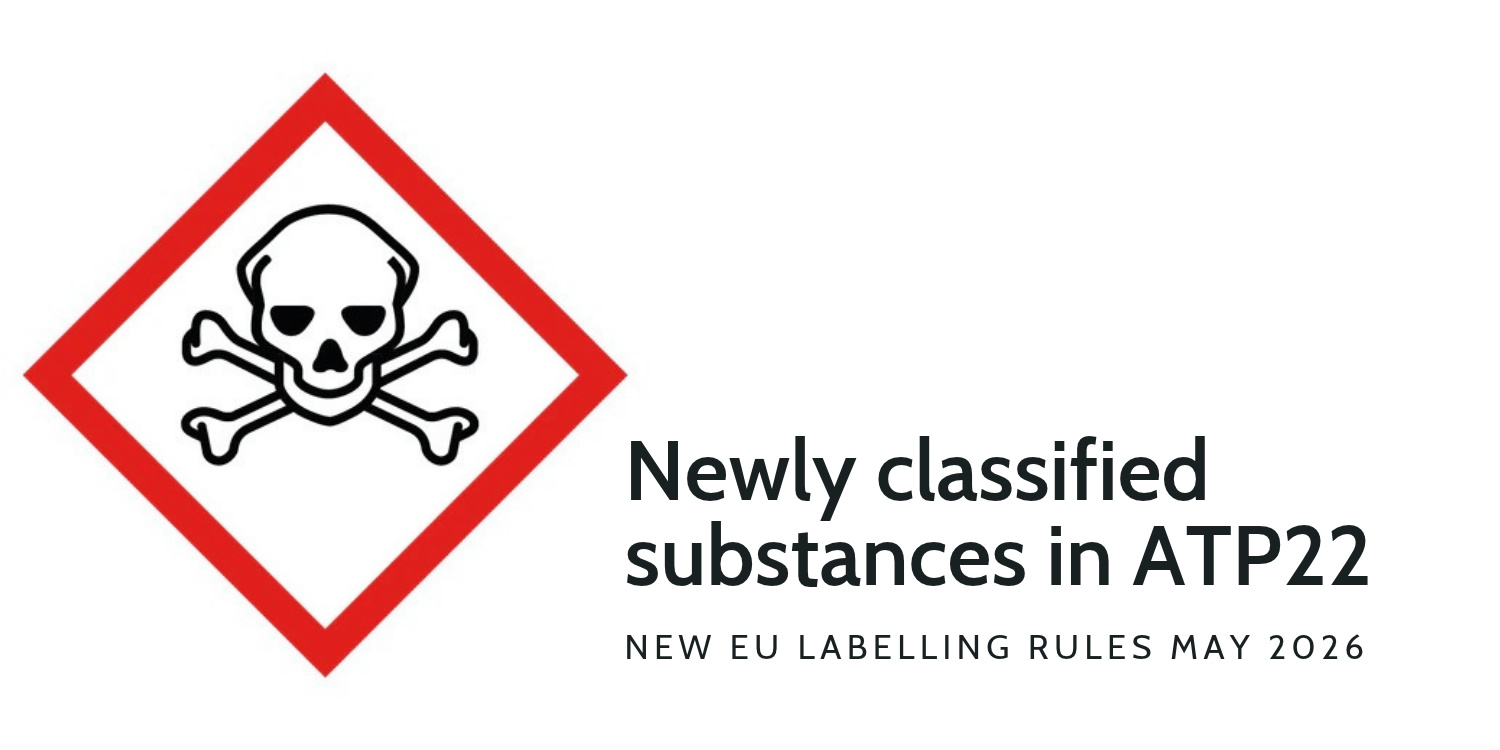
The EU regularly updates its legislation on the classification and labelling of chemical products through the CLP Regulation (Classification, Labelling and Packaging). The latest update, ATP22, means that more than 40 substances and groups of substances receive a new or amended EU-harmonised classification and labelling.
For companies that manufacture, import or sell chemical products in the EU, this can mean having to update labels, safety data sheets and packaging. The new rules have been mandatory since 1 May 2026.
In this article we go through what ATP22 means and what companies need to do to meet the new requirements under the CLP Regulation.
Please note: ATP22 is an EU regulation. It applies in the EU and in Northern Ireland, but not automatically in Great Britain, where the GB CLP Regulation and the GB mandatory classification and labelling list (GB MCL) apply instead.
The CLP Regulation governs how chemical products must be classified, labelled and packaged in the EU. The aim is to ensure that hazardous substances are handled correctly and that users receive clear information about the risks.
An important part of the regulation is Annex VI to the CLP Regulation, which lists substances with an EU-harmonised classification. These classifications are harmonised throughout the EU and must be followed by all companies placing substances or mixtures on the market. The annex is updated regularly through adaptations to technical progress, known as ATPs.
The latest update, ATP 22, brings several changes to Annex VI:
Several of the substances were proposed by Sweden in the EU's regulatory work. These include, for example:
For some substances, the update means that previous entries are replaced or merged – for example, where several perborates have been replaced by new common classifications. Companies therefore need to check whether their chemical products contain any of the substances concerned.
According to the Swedish Chemicals Agency, several of the substances in ATP 22 are found in many products on the market. Examples include:
If any of these substances are included in a product, its classification may need to be updated.
The transition period has ended: since 1 May 2026, the new classifications are mandatory for substances and mixtures placed on the EU market.
Companies that have not yet completed the adaptation should therefore, without delay:
How a substance is classified under CLP does not only determine how the product must be labelled. The classification also affects several other regulations and requirements. For example, the classification can determine:
That is why it is important for companies to reassess their products whenever the classification of a substance changes.
For companies working with chemical products, it is important to make sure that products meet the requirements of ATP 22. Recommended actions:
Acting promptly reduces the risk of supply disruptions or products that do not meet legal requirements.
For businesses handling chemicals, it is also important to ensure clear marking in the workplace, for example with chemical warning signs that help inform about hazards and safe handling.

Would you like to find out exactly which substances are affected and which changes ATP22 introduces? You can read the full regulation, Commission Delegated Regulation (EU) 2024/2564, on EUR-Lex.
With a modern machine park and more than 25 employees, we deliver over 10,000 engraved signs and markings every day. Order before 4 pm and your order ships the same day!
📩 Email us at order@knutwall.com
🌐 Order signs and markings online
Knut Wall Marking Systems AB
Org.nr. 556778-0753
 EN
 SV
 NO
 DK
 FI
 DE