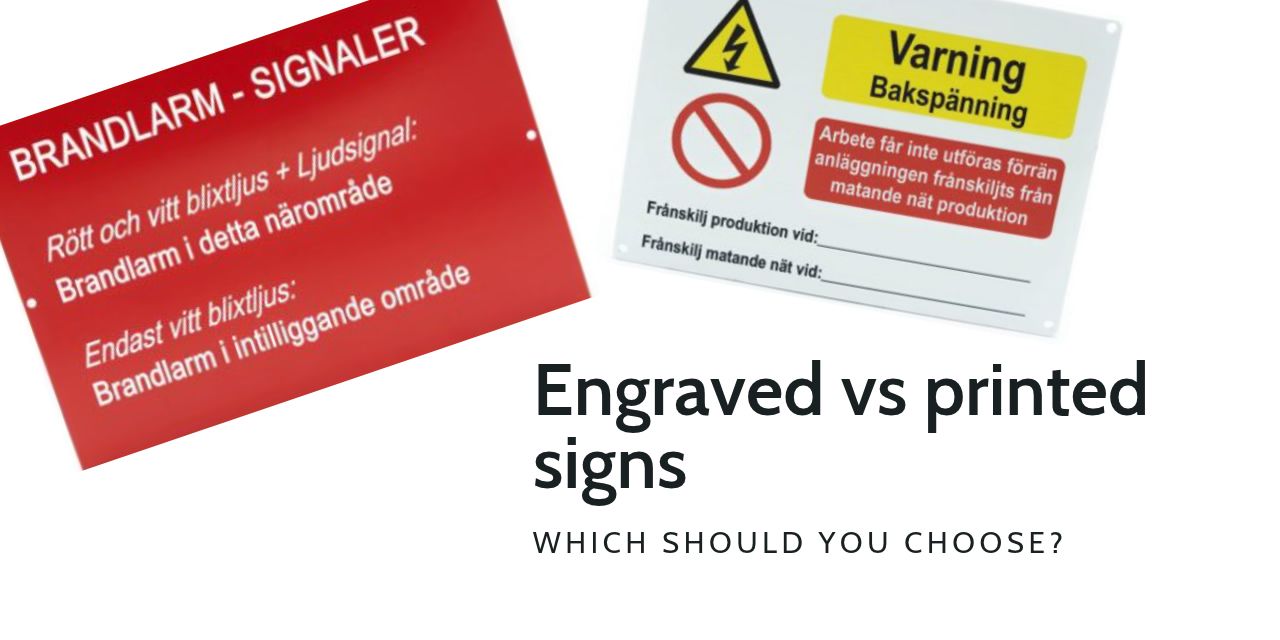
Choosing the right sign is not just about design – it is about durability, application and long-term function. Two of the most common options are engraved signs and printed signs. But what is the actual difference, and which one suits your needs best?
In this guide from Knutwall in Sweden, we go through the pros and cons of both options to help you make the right decision.
Engraved signs are made by milling or laser engraving text and symbols directly into the material. This means the message becomes a permanent part of the sign. Engraved two-layer plastic signs are also known as traffolyte labels.
Common materials:
If you want a durable solution, engraved signs are a very popular choice, especially in industry, property management and public buildings.
Engraved signs have several clear strengths:
Despite their advantages, there are some limitations:
Printed signs are made by printing the design directly onto the surface, often with digital printing or screen printing. This gives much more freedom in the design.
Common materials:
Printed signs offer great flexibility:
This makes them ideal for:
There are, however, some weaknesses:
| Property | Engraved signs | Printed signs |
|---|---|---|
| Durability | Very high | Medium |
| Design freedom | Limited | Very high |
| Service life | Long | Shorter |
| Price | Slightly higher | Often lower |
| Typical use | Permanent labelling | Information and signage in colour |
The choice depends entirely on your needs:
In many cases the two complement each other – printing is used for visibility and engraving for permanent labelling.
Want to go deeper into materials? Read our guide on choosing the right material for your engraved sign, or design your sign directly in our online sign editor.
Knut Wall Marking Systems AB
Org.nr. 556778-0753
 EN
 SV
 NO
 DK
 FI
 DE