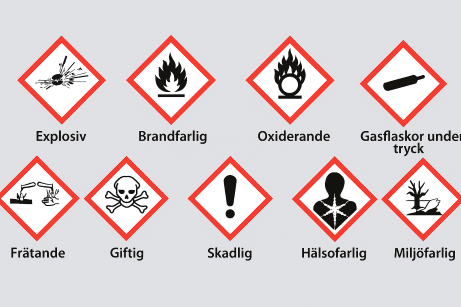
A hazard pictogram is a standardised symbol used to warn of the dangerous properties of chemical products. The hazard symbols are part of the EU CLP Regulation and make it possible to quickly identify risks such as flammability, corrosive substances or serious health hazards. Thanks to their uniform design, hazard pictograms can be understood regardless of language and contribute to safer handling of chemicals in industry, laboratories, warehouses and other workplaces.
Need to label chemicals or workplaces? At Knutwall we make printed signs and stickers with hazard pictograms for clear and durable safety labelling.
The purpose of hazard pictograms is to communicate quickly which risks a chemical product involves. The symbols are used on chemical packaging, safety data sheets and safety signs to give the user important information before the product is handled.
Each hazard pictogram represents a specific type of hazard and helps prevent accidents by making the risks clear at first glance. All CLP pictograms have the same design: a black symbol on a white background inside a red diamond.
Under the CLP Regulation there are nine hazard pictograms used within the EU. Each one has a GHS code and represents a specific type of hazard:
| Code | Pictogram | Meaning |
|---|---|---|
| GHS01 | Exploding bomb | Explosive substances |
| GHS02 | Flame | Flammable substances |
| GHS03 | Flame over circle | Oxidising substances |
| GHS04 | Gas cylinder | Gases under pressure |
| GHS05 | Corrosion | Corrosive to skin and metals |
| GHS06 | Skull and crossbones | Acute toxicity |
| GHS07 | Exclamation mark | Irritant or harmful substances |
| GHS08 | Health hazard | Serious health hazards, e.g. carcinogenic |
| GHS09 | Environment | Hazardous to the aquatic environment |
The old orange hazard symbols with a black cross or skull were replaced by the CLP pictograms and have not been allowed on new labels since 2015.
A hazard pictogram never stands alone. On a CLP label it is combined with:
Together they give a clear picture of the product’s properties and how it should be handled safely.
Hazard pictograms are used on chemical products classified as hazardous under the CLP Regulation – for example cleaning agents, solvents, paints, gas cylinders and industrial chemicals. They are also used on safety signs in workplaces where chemicals are handled or stored.
By labelling both products and workplaces, it becomes easier to identify risks and choose the right protective measures before work begins.
The CLP Regulation (EC No 1272/2008) governs how chemical substances and mixtures are classified, labelled and packaged within the EU. It is based on the UN’s global GHS system, and the aim is uniform labelling that makes it easier to understand the risks of a product.
This guide is written from a Swedish perspective. CLP applies in the same way throughout the EU/EEA, while rules for warning signs in the workplace are national – in Sweden they are set by the Swedish Work Environment Authority. Always check which rules apply in your country.
Hazard pictograms and chemical hazard signs are often used together but serve different purposes. A hazard pictogram is the symbol describing the chemical risk on the product, while a chemical hazard sign informs about risks in the surrounding work environment or where chemicals are stored and handled.
Combining correct product labelling with clear hazard signs creates a safer workplace where both staff and visitors can quickly identify potential risks.
At Knutwall you can design printed signs and stickers with hazard pictograms for industry, laboratories, warehouses and other workplaces where chemicals are handled. Our signs are made of hard-wearing materials for clear and long-lasting labelling.
With a modern machine park and more than 25 employees, we deliver over 10,000 signs and labels every day. Everything is produced in our own factory in Södertälje, Sweden, and shipped from there with fast delivery.
📩 Email us at order@knutwall.com
🌐 Design your sign online
Knut Wall Marking Systems AB
Org.nr. 556778-0753
 EN
 SV
 NO
 DK
 FI
 DE